ICE and OKX: The New York Stock Exchange Embraces Tokenization
ICE, parent of the NYSE, partners with OKX to bring tokenized securities to Wall Street. A historic turning point for traditional finance.
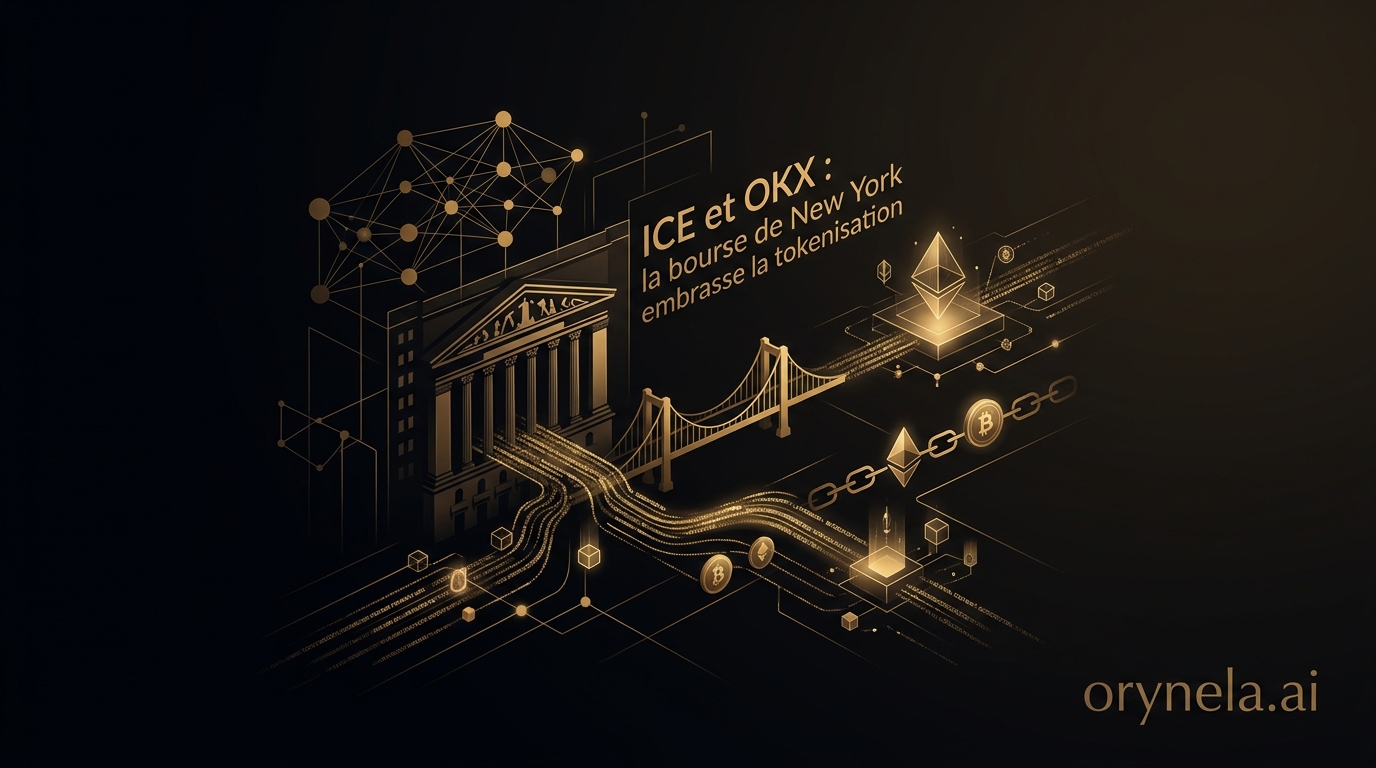
ICE and OKX: When the New York Stock Exchange Embraces Tokenization
In a move that could redefine the very architecture of global finance, Intercontinental Exchange (ICE), the parent company of the New York Stock Exchange (NYSE), has announced a strategic partnership with OKX, one of the world's largest cryptocurrency exchanges. The goal: bringing tokenized securities on blockchain to Wall Street.
This alliance marks a decisive turning point in the historic convergence between traditional finance (TradFi) and the digital asset ecosystem. It comes as the tokenization market accelerates, with projections forecasting a $16 trillion market by 2030 according to Boston Consulting Group.
What Exactly Is This About?
The partnership between ICE and OKX aims to create infrastructure enabling the issuance, listing, and trading of tokenized securities — that is, traditional financial assets (stocks, bonds, funds) represented as tokens on a blockchain.
Specifically, ICE brings its regulatory expertise, deep market knowledge, and global listing infrastructure. On its side, OKX provides blockchain technology, digital custody wallets, and expertise in on-chain liquidity.
Tokenization: An Ongoing Revolution
Tokenization involves representing a real-world asset in digital form on a blockchain. This representation offers several major advantages:
Fractionalization: a high-value asset (like real estate or government bonds) can be divided into millions of tokens, democratizing access to investments.
24/7 Liquidity: unlike traditional markets that close on weekends, tokenized assets can be traded continuously.
Reduced intermediaries: blockchain automates many processes (settlement, custody, ownership transfer), reducing transaction costs.
Transparency: every transaction is immutably recorded on the blockchain, facilitating audits and compliance.
Why This Alliance Is Historic
What makes this partnership truly revolutionary is the mutual credibility that both parties bring. ICE is no ordinary player: it operates the oldest stock exchange in the United States, founded in 1792. Its commitment to tokenization sends a powerful signal to the entire financial industry.
For its part, OKX, which processes daily volumes in the billions of dollars, has demonstrated the robustness of its blockchain infrastructure through extreme market cycles. Its entry into the world of institutional tokenization validates the technology's maturity.
Beyond Symbolism: Concrete Use Cases
The initial applications targeted by the partnership include:
• Tokenization of corporate and sovereign bonds • Creation of tokenized funds accessible to accredited investors • Hybrid derivative instruments combining traditional and on-chain exposure • Instant settlement solutions using stablecoins
Impact on the Financial Ecosystem
This partnership announcement comes in a particularly favorable context. In 2026, real-world asset (RWA) tokenization has become one of the fastest-growing segments of the crypto economy. According to data from RWA.xyz, the total value of tokenized assets has surpassed $20 billion, with clear acceleration since the approval of Bitcoin and Ethereum ETFs.
The implications for traditional players are profound. Investment banks, asset managers, and even exchanges themselves must now integrate blockchain into their strategic roadmaps. Those who ignore this transformation risk being disintermediated.
Regulatory Challenges and Outlook
While the potential is immense, several obstacles remain. The U.S. regulatory framework around digital assets is still evolving, with persistent tensions between the SEC and CFTC over jurisdiction of certain instruments. The European Union, with its MiCA regulation, has taken a lead, but global standards remain fragmented.
The ICE-OKX partnership could precisely play a regulatory catalyst role. By pairing a heavily regulated player like ICE with a leading crypto infrastructure, it creates a precedent that could encourage regulators to accelerate the establishment of clear frameworks.
Is the Future of Wall Street On-Chain?
With this alliance, one thing becomes clear: the question is no longer whether traditional finance will adopt blockchain, but when and how. Tokenization is no longer a marginal experiment conducted by startups — it is now driven by the most powerful institutions on the planet.
For investors, this means the upcoming arrival of more accessible, more liquid, and potentially less expensive products. For the crypto industry, it is a historic validation of blockchain technology's relevance at the heart of the global financial system.
Whether this vision materializes quickly or operational and regulatory realities slow the momentum remains to be seen. One thing is certain: Wall Street will never be quite the same again.
⚠️ Warning: Trading and investing involve risks. Past performance does not guarantee future results. Always do your own research before investing.
forum 0 comments
Log in to join the discussion.
Log inNo comments yet. Start the conversation!
Keep it civil and constructive. Comments are public and moderated.